


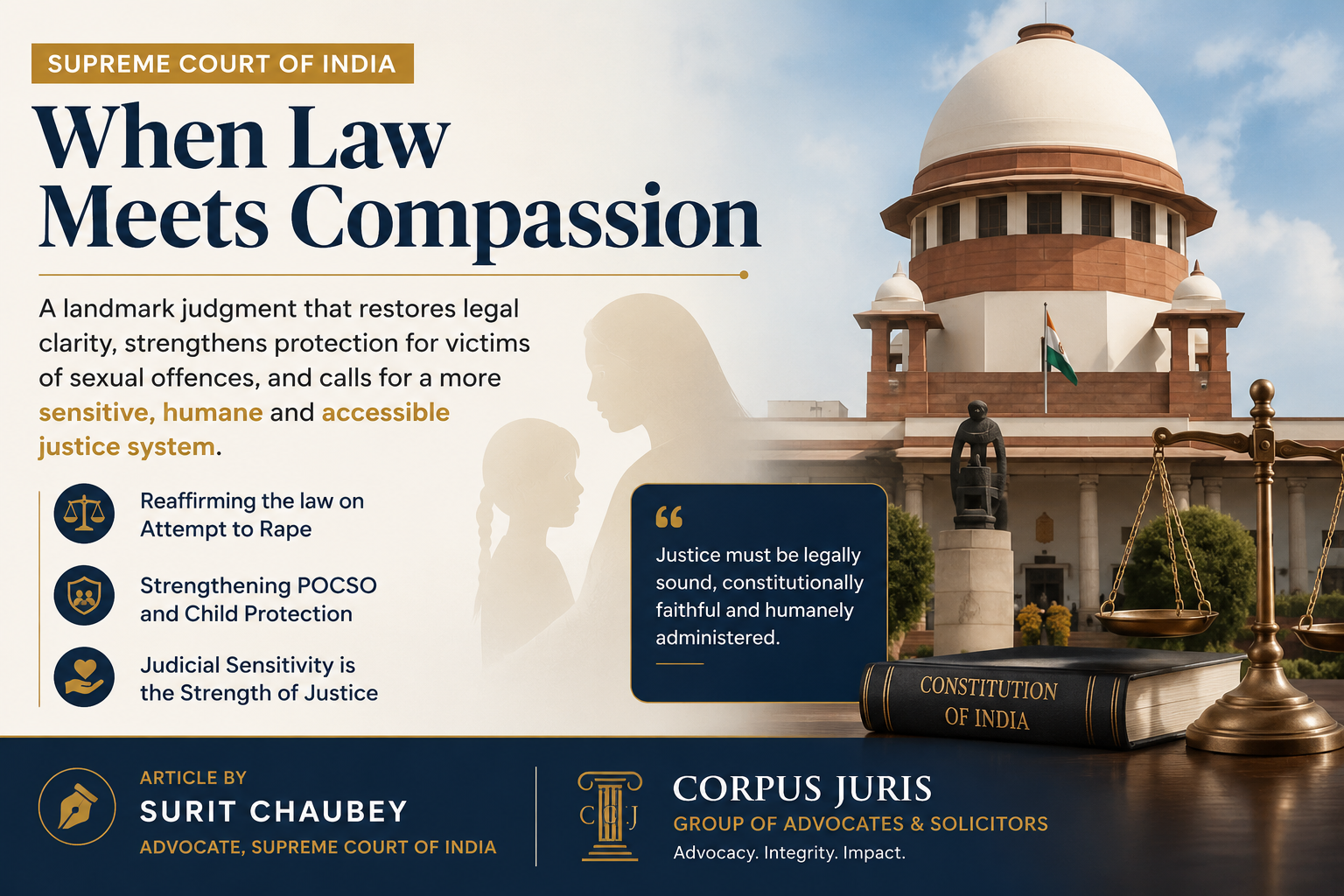
The Supreme Court of India, through its remarkable judgment dated 10 February 2026 in In Re: Order dated 17.03.2025 Passed by the High Court of Judicature at Allahabad in Criminal Revision No. 1449/2024 and Ancillary Issues, has delivered far more than a correction of legal error. It has reaffirmed a foundational principle of constitutional justice—that the law must not only be interpreted with intellectual rigour but also applied with humanity, sensitivity and an appreciation of the lived realities of victims who approach the justice delivery system seeking protection and redressal.
The controversy arose from an order of the Allahabad High Court wherein allegations against the accused were diluted on the reasoning that the acts attributed to them constituted mere preparation and not an attempt to commit rape. The Supreme Court was therefore called upon to examine one of the most significant distinctions in criminal jurisprudence: the difference between preparation and attempt. Reiterating settled principles of criminal law, the Court emphatically held that once an offender moves beyond planning and begins executing the criminal intent, the offence enters the realm of attempt. The law does not require the final consummation of the offence before criminal liability can arise. Where criminal intent manifests itself through overt acts directed towards the commission of the offence, the threshold of attempt is crossed.
Applying these principles to the allegations on record, the Supreme Court found that the accused had allegedly lured a minor victim under a false pretext, transported her to an isolated location, dragged her towards a culvert and commenced acts that unmistakably indicated the execution of a premeditated criminal design. The Court observed that the alleged offence was interrupted not because of any voluntary withdrawal on the part of the accused but solely due to the intervention of third-party witnesses who arrived upon hearing the cries of the victim. In such circumstances, the Court rightly concluded that the allegations disclosed a prima facie case of attempt to commit rape and restored the original summons issued by the Special POCSO Court.
What transforms this judgment from a routine appellate correction into a jurisprudential milestone is the Supreme Court’s willingness to confront a deeper institutional concern. The Court candidly acknowledged that certain judicial observations and approaches in sexual offence cases have, on occasions, reflected an absence of empathy towards victims, particularly women and children. Such observations not only undermine public confidence in the justice system but risk inflicting secondary trauma upon survivors who seek justice through judicial processes.
The judgment contains a profound reminder that courts are not merely forums for the mechanical application of statutes. They are constitutional institutions entrusted with the preservation of dignity, liberty and human rights. Judicial neutrality cannot be equated with emotional indifference. The pursuit of objectivity does not require courts to become detached from the realities of human suffering. On the contrary, the legitimacy of the justice system is strengthened when legal reasoning is accompanied by compassion, sensitivity and an understanding of social vulnerabilities.
Recognising the need for systemic reform rather than isolated criticism, the Supreme Court has taken an unprecedented and visionary step by directing the constitution of an Expert Committee under the aegis of the National Judicial Academy, Bhopal. Chaired by former Supreme Court Judge Justice Aniruddha Bose, the Committee has been tasked with preparing comprehensive recommendations and draft guidelines aimed at inculcating sensitivity and compassion within judicial processes, particularly in cases involving sexual offences and vulnerable victims. This initiative has the potential to reshape judicial training, courtroom practices and institutional culture across the country.
Equally significant is the Court’s emphasis on accessibility and inclusivity. The judgment recognises that justice cannot remain confined within complex legal vocabulary and technical expressions that are incomprehensible to ordinary citizens. The Court has encouraged the formulation of guidelines in simple, understandable language and has highlighted the importance of recognising culturally specific expressions that may reveal experiences of abuse and trauma. Such observations demonstrate a judicial awareness that access to justice begins with the ability of victims to narrate their experiences without fear, confusion or institutional barriers.
In my considered opinion, this judgment represents one of the most progressive and socially responsive pronouncements delivered by the Supreme Court in recent years. The Court has successfully balanced the demands of legal precision with the constitutional imperative of human dignity. It has reaffirmed that criminal law must not be interpreted in a manner that inadvertently shields offenders through artificial distinctions divorced from factual realities. More importantly, it has reminded the legal fraternity that justice is not merely an abstract legal concept; it is a lived experience for those who place their faith in the judicial system.
The decision sends a powerful message that sensitivity is not a weakness of judicial institutions but one of their greatest strengths. A justice system that understands vulnerability, respects dignity and remains attentive to the voices of victims is ultimately a stronger, fairer and more credible institution. By restoring the correct legal position and simultaneously initiating a national conversation on compassionate adjudication, the Supreme Court has demonstrated that constitutional courts are not only interpreters of law but also guardians of human dignity.
This judgment will undoubtedly be remembered not merely for its exposition of the law relating to attempt to commit rape but for its larger vision of a justice system that is legally sound, socially conscious and fundamentally humane. In an era where public confidence in institutions is increasingly tested, the Supreme Court has once again reaffirmed that the rule of law must always walk hand in hand with compassion.
Surit Chaubey
Advocate, Supreme Court of India
Founder & Managing Partner
Corpus Juris Group of Advocates & Solicitors
Judgement: judgement