


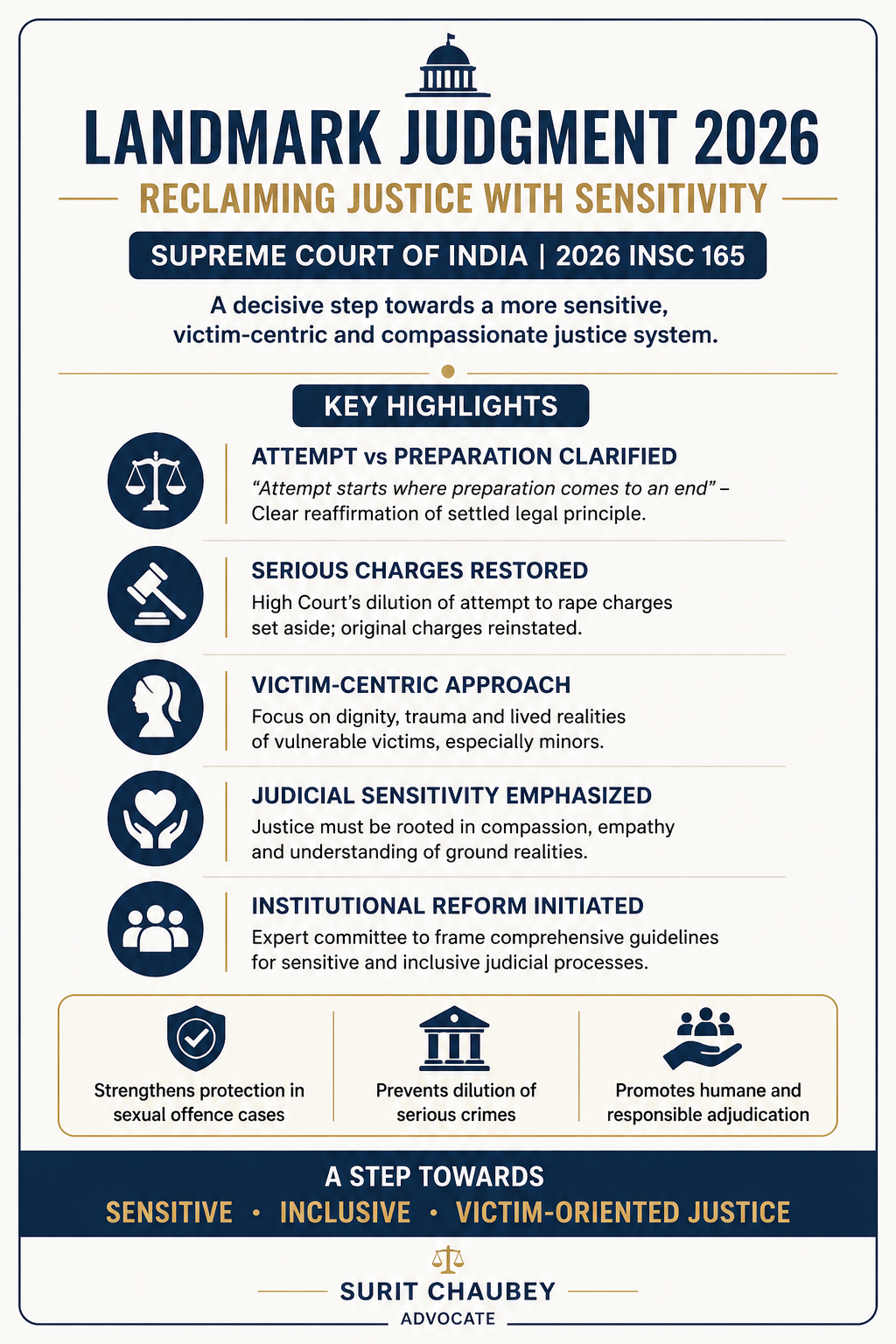
The recent judgment of the Supreme Court of India in 2026 INSC 165 stands as a powerful reaffirmation of both doctrinal clarity and humane judicial reasoning. The Court intervened to correct a legally flawed approach adopted by the Allahabad High Court, which had diluted serious charges of attempt to rape into lesser offences by treating the acts as mere “preparation.” Restoring the original charges, the Supreme Court held that the factual matrix clearly crossed the threshold into “attempt,” thereby reinforcing that grave offences cannot be trivialized through narrow interpretation.
Crucial Legal Principle: Preparation vs Attempt
The Court relied on settled jurisprudence and clearly articulated the distinction:
“There is a visible distinction between ‘preparation’ and ‘attempt’ to commit an offence… ‘Attempt’ is the execution of mens rea after preparation. ‘Attempt’ starts where ‘preparation’ comes to an end…”
This principle forms the backbone of criminal liability and was correctly applied to the facts of the present case.
Application to Facts: A Clear Case of Attempt
While applying the law, the Court made a decisive observation:
“A bare perusal of these allegations leaves no modicum of doubt… the mens rea involved had begun to be executed.”
Further, the Court held:
“The attempt made by the accused persons appears clearly… a case for invoking the provisions of attempt to commit rape has been made out.”
These findings categorically reject the dilution of charges and restore the seriousness of the offence in line with established legal principles.
On Judicial Sensitivity and Approach
The judgment also addresses a deeper concern within the justice delivery system:
“Our efforts must not only be grounded in the sound application of… legal principles but also foster an environment of compassion and empathy.”
The Court further observed:
“No judge or judgment… can be expected to do complete justice when it is inconsiderate towards the factual realities of a litigant…”
These observations underline that justice must be responsive to the lived realities of victims, particularly in cases involving minors and vulnerable individuals.
Institutional Reform: A Forward-Looking Direction
Adopting a structured and long-term approach, the Court directed the National Judicial Academy, Bhopal to constitute an expert committee. The objective is to develop comprehensive and accessible guidelines:
“Developing Guidelines to Inculcate Sensitivity and Compassion into Judges and Judicial Processes…”
The Court also emphasized inclusivity and accessibility:
“The draft guidelines… may be understood and utilized easily… irrespective of their background and means.”
This direction reflects a significant step towards strengthening a victim-centric judicial framework.
Key Takeaways
- Clear reaffirmation of law: Attempt begins where preparation ends
- Correction of judicial error: Dilution of serious charges set aside
- Recognition of victim dignity: Sensitivity treated as essential to justice
- Systemic reform initiated: Expert committee for structured guidelines
- Focus on accessibility: Emphasis on simple, inclusive legal communication
Analytical Note
This judgment represents a decisive assertion that criminal law cannot be interpreted in isolation from ground realities. The Supreme Court has ensured that doctrinal precision does not come at the cost of justice to victims. By addressing both the legal misinterpretation and the broader issue of judicial sensitivity, the ruling strengthens the integrity of the justice system while setting the stage for meaningful institutional reform. It reinforces the principle that adjudication, particularly in cases involving sexual offences, must reflect not only legal correctness but also empathy, awareness, and responsibility.
— Surit Chaubey, Advocate