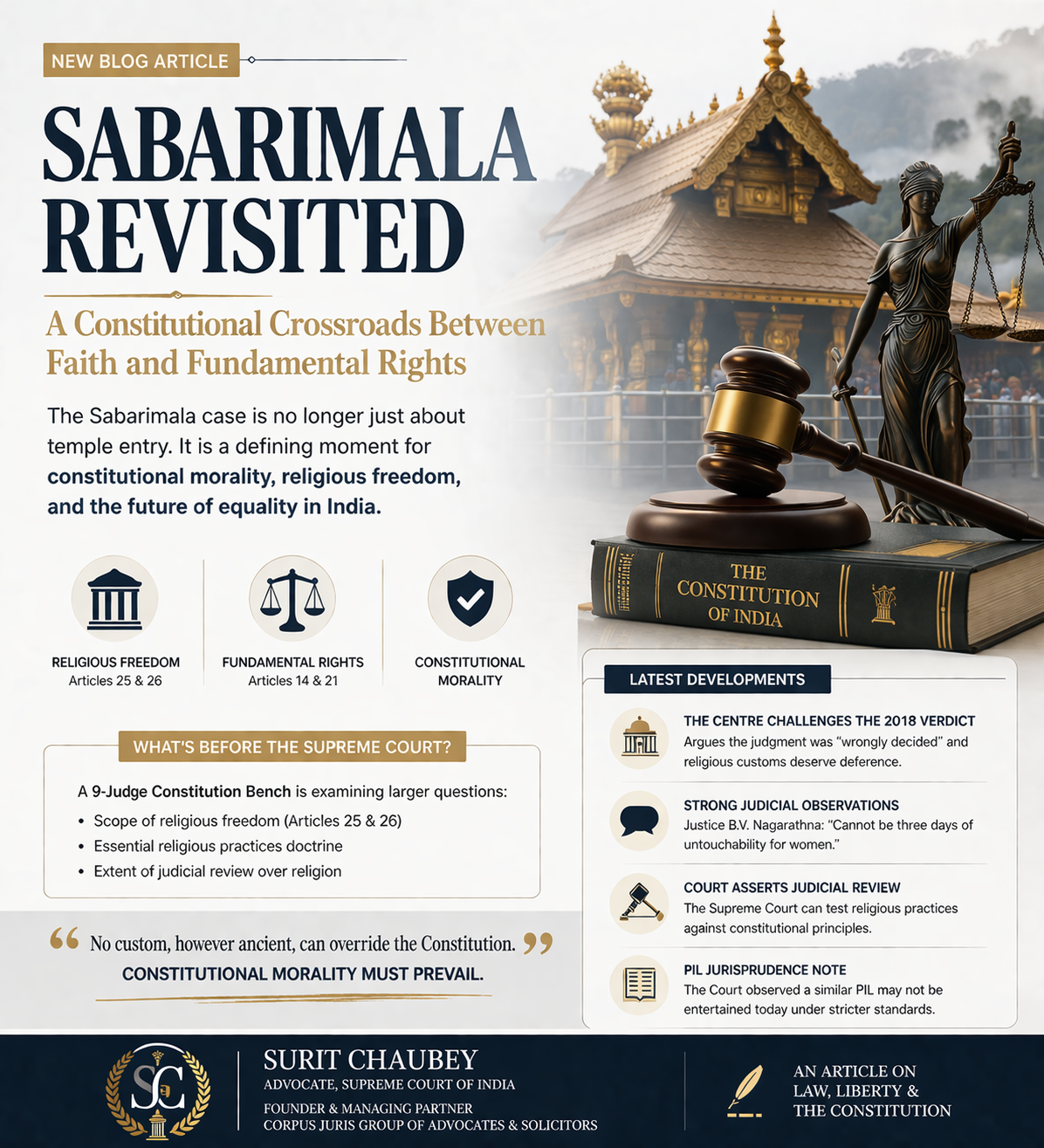
The ongoing constitutional reference arising out of the Indian Young Lawyers Association v. State of Kerala, in my considered opinion, has transcended the narrow contours of a temple-entry dispute and now squarely situates itself at the heart of India’s constitutional conscience, compelling a decisive determination by the Supreme Court of India on the perennial tension between faith and fundamental rights; while the Union Government of India has sought to reassert the primacy of religious autonomy by questioning the correctness of the 2018 verdict, it is trite that the guarantees under Articles 25 and 26 cannot be construed in isolation so as to eclipse the inviolable mandate of equality, dignity, and personal liberty enshrined under Articles 14 and 21, for to permit exclusionary practices grounded in notions of purity or tradition would be to constitutionalize discrimination under the guise of faith, a proposition fundamentally antithetical to the transformative ethos of our Constitution; in my respectful view, the doctrine of constitutional morality must operate as the controlling principle, ensuring that no custom, however ancient or revered, is permitted to transgress the foundational values of justice and human dignity, and therefore, the ultimate adjudication in the Sabarimala matter will not merely determine the permissibility of a religious practice but will indelibly shape the contours of judicial review, the scope of essential religious practices, and the enduring supremacy of the Constitution as a living and progressive instrument over all forms of social and religious orthodoxy.