


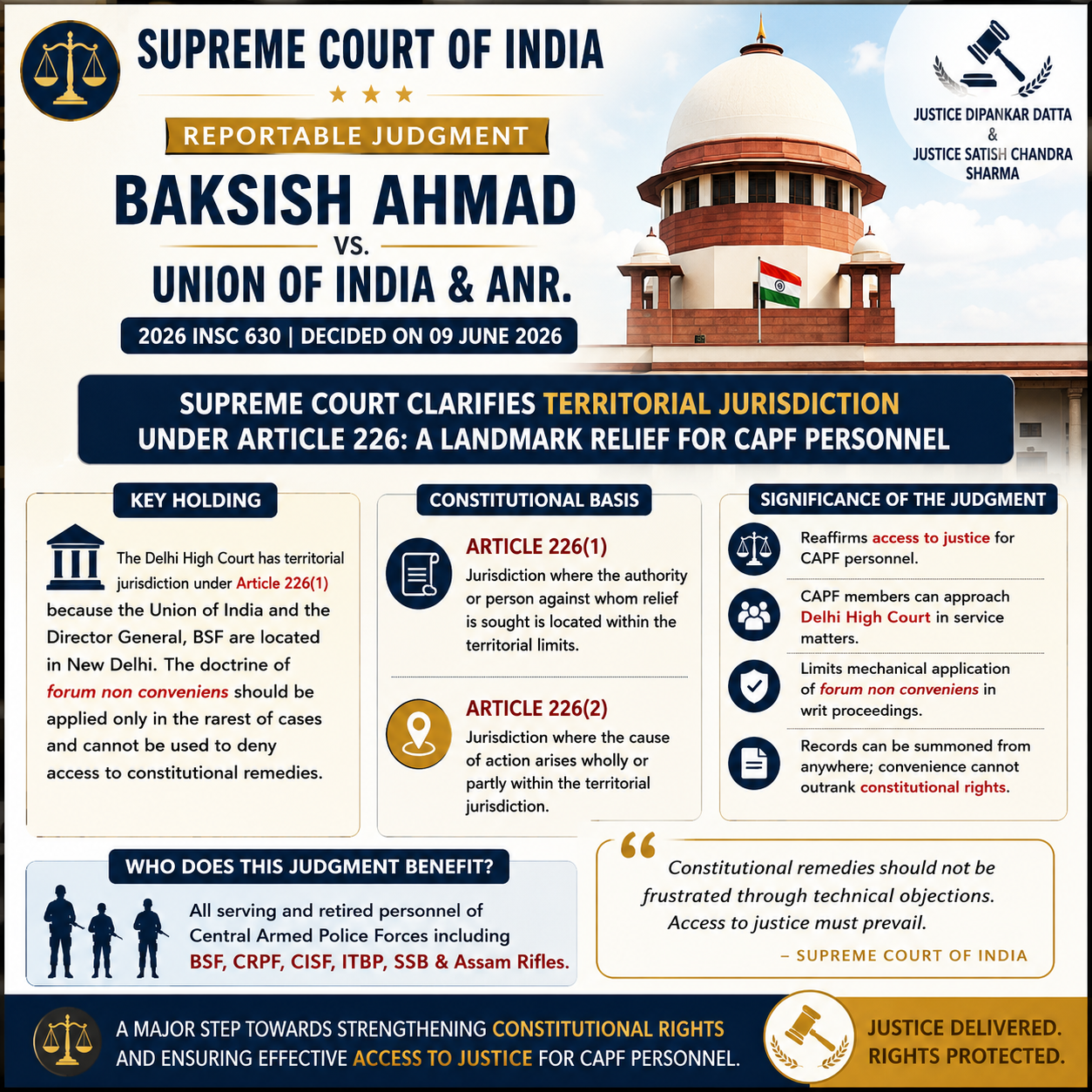
Supreme Court Clarifies Territorial Jurisdiction Under Article 226: A Landmark Relief for CAPF Personnel
By Surit Chaubey
Advocate, Supreme Court of India
Founder & Managing Partner, Corpus Juris Group Advocates & Solicitors
Introduction
In a landmark and reportable judgment delivered on 09 June 2026 in Baksish Ahmad v. Union of India & Anr. (2026 INSC 630), the Hon’ble Supreme Court of India has significantly clarified the scope of territorial jurisdiction under Article 226 of the Constitution of India and the applicability of the doctrine of forum non conveniens in service jurisprudence involving members of the Central Armed Police Forces (CAPFs).
The judgment is of far-reaching importance not only for personnel serving in the Border Security Force (BSF) but also for members of other CAPFs, including the CRPF, CISF, ITBP, SSB and Assam Rifles. The Court has reaffirmed the constitutional right of access to justice and cautioned against the mechanical application of the doctrine of forum non conveniens in writ proceedings.
Background of the Case
The appellant, a member of the Border Security Force, was dismissed from service after a departmental inquiry concluded that he had contracted a second marriage during the subsistence of his first marriage without obtaining the requisite permission from the competent authority.
Following the rejection of his statutory petition by the Inspector General, BSF, Jammu, the appellant approached the Delhi High Court under Article 226 seeking reinstatement and challenging the dismissal order.
The Delhi High Court, however, declined to entertain the writ petition. It held that since the dismissal order had been passed in West Bengal and the statutory petition had been rejected in Jammu & Kashmir, the Delhi High Court was not the appropriate forum and invoked the doctrine of forum non conveniens.
Aggrieved by this decision, the appellant approached the Supreme Court.
The Core Legal Question
The principal issue before the Supreme Court was:
Whether the Delhi High Court could refuse to entertain a writ petition under Article 226 solely on the ground of forum non conveniens when the Union of India and the Director General of the BSF, against whom relief was sought, were located within the territorial jurisdiction of Delhi?
This question directly implicated the interpretation of Article 226(1) and Article 226(2) of the Constitution.
Article 226: Understanding the Constitutional Framework
Article 226 confers extraordinary writ jurisdiction upon High Courts.
The Supreme Court explained that:
- Article 226(1) permits a High Court to exercise jurisdiction where the authority or person against whom relief is sought is located within its territorial limits.
- Article 226(2) permits a High Court to exercise jurisdiction where the cause of action arises wholly or partly within its territorial jurisdiction.
The Court emphasized that these are two independent constitutional foundations of jurisdiction.
Reliance on Earlier Precedents
The Supreme Court extensively examined previous decisions, including:
- Abrar Ali v. CISF
- Shri Ranjeet Mal v. General Manager, Northern Railway
- Eastern Coalfields Ltd. v. Kalyan Banerjee
- Dinesh Chandra Gahtori v. Chief of Army Staff
- Kusum Ingots & Alloys Ltd. v. Union of India
- Arif Azim Co. Ltd. v. Micromax Informatics FZE
After harmonizing these precedents, the Court reaffirmed the principle laid down in Abrar Ali that where the headquarters of the concerned force and the Union of India are situated in Delhi, the Delhi High Court possesses territorial jurisdiction under Article 226(1).
Supreme Court’s Landmark Findings
1. Delhi High Court Possessed Jurisdiction
The Supreme Court categorically held that the Delhi High Court had territorial jurisdiction because:
- The Union of India was a necessary party.
- The Director General, BSF, who exercises command and administrative control over the force, is located in New Delhi.
- Orders of dismissal passed under the BSF Rules are mandatorily reported to the Director General.
Accordingly, jurisdiction was clearly attracted under Article 226(1).
2. Forum Non Conveniens Was Misapplied
The Court strongly criticised the manner in which the doctrine of forum non conveniens was invoked.
According to the Supreme Court, the doctrine ordinarily applies where multiple competent forums exist and a litigant has approached a forum that may be genuinely inconvenient for adjudication.
However, where a litigant invokes the constitutional writ jurisdiction of a High Court under Article 226(1), the doctrine should be applied only in the rarest of circumstances.
The Court observed that directing litigants away from a constitutionally competent forum may impede access to justice rather than advance it.
3. Access to Justice Must Prevail
One of the most significant observations of the judgment is the Court’s recognition that constitutional remedies should not be frustrated through technical objections relating to convenience.
The Supreme Court emphasized that records can always be summoned from any part of the country and that modern governance structures should not be used as a ground to deny citizens and service personnel access to constitutional courts.
4. Relief for CAPF Personnel Nationwide
The Court expressly held that members of CAPFs can invoke the jurisdiction of the Delhi High Court in service matters because the Union of India and the respective Director General of the concerned force are stationed in Delhi.
This principle has major implications for thousands of serving and retired personnel across India.
Why This Judgment Matters
This decision is likely to become a leading authority on:
- Territorial jurisdiction under Article 226.
- Service matters involving Central Armed Police Forces.
- Limits on the doctrine of forum non conveniens.
- Access to constitutional remedies.
- Jurisdiction of the Delhi High Court in cases involving central authorities.
The ruling strengthens the constitutional guarantee that legal remedies should remain practical, accessible and effective.
Key Takeaways
✔ Delhi High Court can exercise jurisdiction under Article 226(1) where the Union of India and the Director General of a CAPF are located in Delhi.
✔ The existence of another High Court with jurisdiction does not automatically justify refusal to entertain a writ petition.
✔ The doctrine of forum non conveniens must be applied sparingly in constitutional writ proceedings.
✔ Access to justice remains a paramount constitutional consideration.
✔ The judgment provides substantial procedural relief to CAPF personnel seeking judicial review of disciplinary and administrative actions.
Conclusion
The Supreme Court’s judgment in Baksish Ahmad v. Union of India is a powerful reaffirmation of constitutional access to justice and a significant development in the law governing territorial jurisdiction under Article 226. By setting aside the Delhi High Court’s order and restoring the writ petition for adjudication on merits, the Court has ensured that procedural technicalities do not overshadow substantive justice.
The decision will undoubtedly serve as an authoritative precedent for future service law disputes involving members of the Central Armed Police Forces and will occupy an important place in the evolving jurisprudence on writ jurisdiction and forum convenience in India.
Judgement: 694202025_2026-06-09